
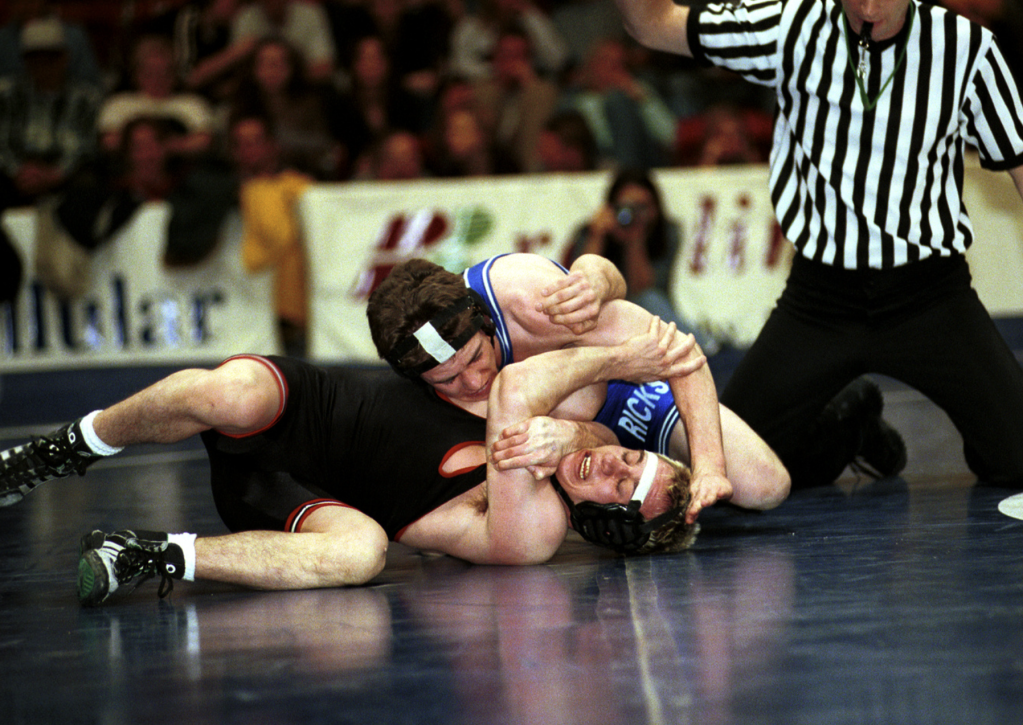
Intercollegiate wrestling has one of the richest athletic traditions in Idaho, and Ricks College once stood at the center of that story. The Vikings fielded a powerhouse program that produced national champions and even an Olympic gold medalist in Rulon Gardner, who stunned the world in 2000 by defeating Russian legend Aleksandr Karelin in Sydney. Wrestling was a point of pride for Ricks alumni, and its legacy still echoes across the region. Yet despite this proud history, bringing wrestling back to BYU–Idaho today would be extremely difficult. The barriers come from Title IX compliance, financial realities, and the broader national decline of the sport at the NCAA Division I level.
The most pressing issue is Title IX. The law requires that schools provide equitable athletic opportunities for men and women. Because wrestling is a men’s-only NCAA sport, it immediately raises compliance concerns. Institutions with large football rosters often cut men’s programs like wrestling to help balance opportunities. At BYU–Idaho, adding wrestling would necessitate adding new women’s teams to maintain proportionality. That requirement adds significant cost and administrative complexity. Even though women’s wrestling is growing, it is not yet widespread enough in NCAA competition to offset these challenges.
Financial pressures make the prospect even more difficult. While mats and uniforms are inexpensive, the true costs of operating a collegiate wrestling program come from scholarships, coaching salaries, recruiting, and travel. At the Division I level, teams may award up to 9.9 scholarships, which can quickly escalate budgets. Penn State, for example, spent $1.8 million on wrestling in 2014, while NC State spent $884,000. These numbers pale in comparison to football’s $19 million annual expenses but are still significant when weighed against the minimal revenue wrestling brings in. For BYU–Idaho, which has not operated varsity athletics since 2001, absorbing such costs without revenue return would be impractical.
Revenue generation is where wrestling faces its steepest uphill climb. Football and basketball sustain most athletic departments because of ticket sales, sponsorships, and media rights. Wrestling, even at its strongest programs, does not match those figures. Regular-season duals rarely fill arenas, and while NCAA championships sell out, those dollars do not trickle down to most institutions. A new athletic department at BYU–Idaho would almost certainly prioritize sports that can engage more students and fans while carrying lower compliance risks.
The national decline of wrestling sponsorship at the Division I level illustrates the sport’s fragile position. Since 1988–89, 41 Division I wrestling programs have been cut, the largest drop among any men’s sport. Today only 76 Division I schools sponsor wrestling, down from more than 100 just a few decades ago. States like Ohio, once wrestling hotbeds, now have only three Division I teams. The attrition speaks to the pressures schools face and demonstrates why restoring wrestling at a new program would be a gamble.
Other divisions, however, show different patterns. Division II has grown from 43 to 59 teams since the late 1980s, while Division III remains stable with 94 programs. NAIA and NJCAA schools also continue to sponsor wrestling, often because the sport helps them attract male students in an era of declining male enrollment. These institutions operate on enrollment-driven models and rely on tuition revenue from athletes, making wrestling sustainable. BYU–Idaho, on the other hand, has no such incentive. With tens of thousands of students already enrolled and high demand for admission, the university does not need wrestling to boost male enrollment.
Women’s wrestling represents one area of growth and optimism. It is one of the fastest-growing high school sports and has gained traction at the NAIA and NJCAA levels, with NCAA interest continuing to build. While this trend might eventually make wrestling more attractive for institutions seeking Title IX balance, the sport remains primarily male at the NCAA level. For BYU–Idaho, which would need to build an entire athletics structure from scratch, launching women’s wrestling alongside men’s would be a major undertaking.
For alumni who remember the glory days of Ricks College wrestling and the remarkable career of Rulon Gardner, the idea of bringing the sport back to Rexburg is appealing. It carries history, tradition, and pride. Yet the present realities of college athletics make it highly unlikely. Title IX compliance, financial limitations, weak revenue prospects, and national trends all work against it. If BYU–Idaho ever restores varsity athletics, it would almost certainly prioritize sports that require fewer compliance tradeoffs, have lower operating costs, and can engage broader segments of the student body. Wrestling’s legacy at Ricks will always remain strong, but its return to campus is improbable under the current model of intercollegiate athletics.
 BYU-I Sports
Leave a comment